-->

Pages

Poker Writin'

I am happy to say that I have regular readers who have never seen a single poker post on this blog. I am perhaps even more pleased that many of you who originally followed me here in the good olde poker days have stuck with me since I left the poker subculture. This weekend my very good friend and oft times writing partner Amy Calistri has decided to reflect on a series of articles she and I wrote four years ago. The final table of the 2010 World Series of Poker is playing out this weekend, as a homage Amy has reposted on the "Biggest Error in the World's Largest Sporting Event." I completely agree with her characterization of those pieces, she writes:

"The articles were neither fun to write nor particularly well written. But they ended up improving the integrity of the game I love. And for me, the old adage proved true. I didn't care who won or lost. In the end, I cared how the game was played."

For those of you who are poker players the articles might be of interest. To the non-poker readers, Amy's comments on who we were and who we still are might bring some insight into some of the other topics I blog about these days. The opening of the first article contains Amy's current thoughts on who she and I are when we put on our writer's mantle.

LINK to Amy's blog.

Innards of an Attic


Because my view is from the eighth floor in a neighborhood of one and two story homes and apartments, I get to see all the roof action. There is the gentleman in the apartments below who gets up on the flat roof about once a week and exercises facing the sun. He does large arm swings and a bit of quiet meditation, he reminds of an old friend who likes to take a sun bath each morning. 

Another flat-roofed apartment about a block away has had roof leak issues, I know this because after every rain storm a maintenance man gets up there and sweeps away the pooled water. Many of the flat roofs have large puddles after a storm but only this one has a depuddler on duty.

Unfortunately no naked sunbathers in view, in fact no tanners at all; white, well-educated folks tend to be unanimously pale. There is a one story cement block garage a block away that serves as the daytime haunts of a big yellow cat, he prowls the roof and often naps under some low hanging branches from a nearby tree which also serves as his ladder. 

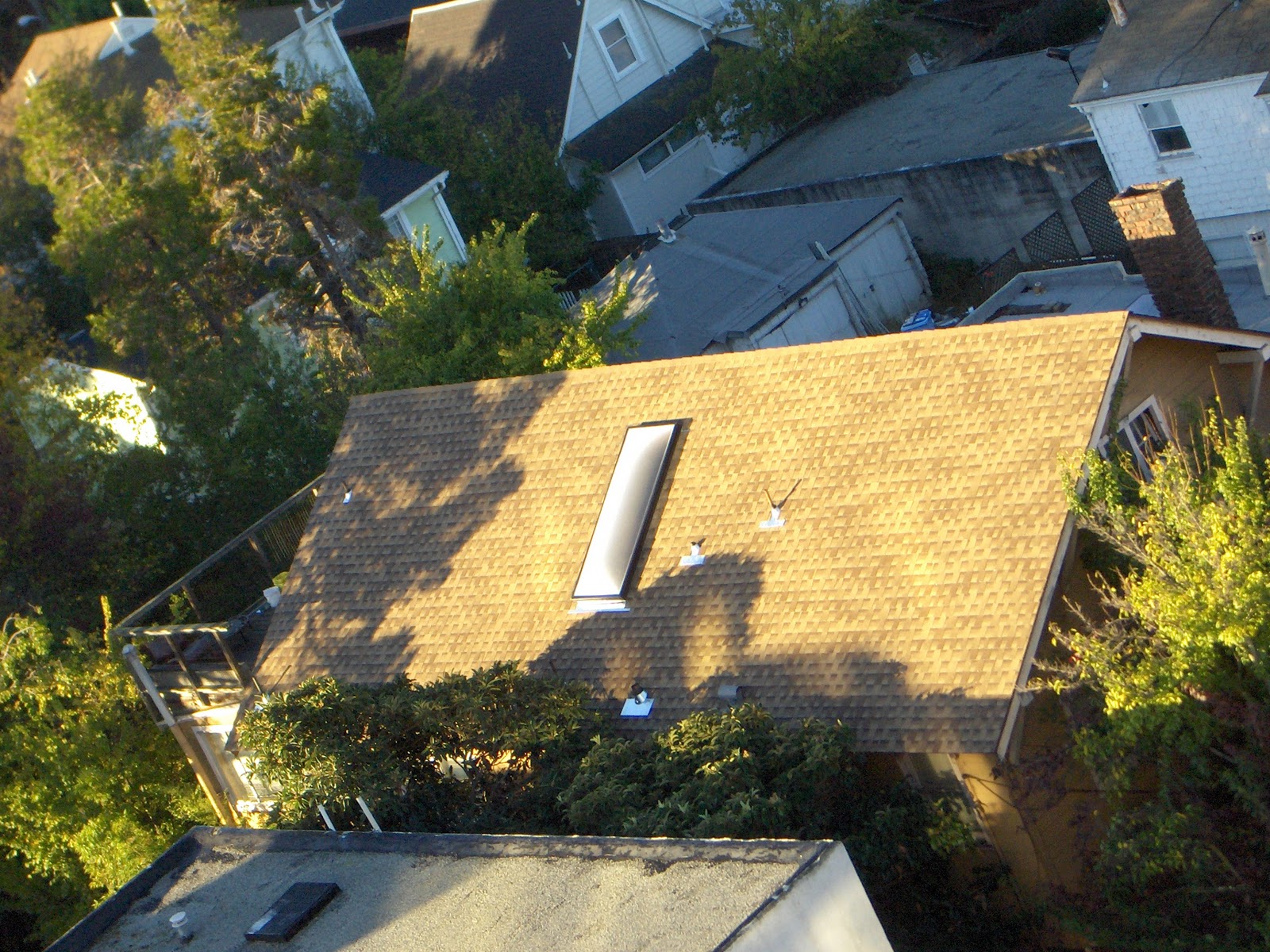
And then there is the large two-story wood shingled house across the street to the south. There are a couple of residents on the second floor but the building also serves as the offices for a low-income housing advocacy group. Several weeks ago a small group of workers swarmed the roof one morning and began to remove shingles on the far side, I suspected a roof patching job was in progress. The next day there was a lot of inspecting and discussion with roofers and periodic others poking their heads out from the attic through a six-by-six hole. A decision must have been reached because on day three the roofers denuded first the far side of the roof and then the side facing my view. All that was left were the ribs of the roof.

Laid out before me were the treasures of an entire attic. At the top of the staircase were filing cabinets then several rows of boxes with access aisles. This corner of the attic clearly supported the housing group. This was an attic being used as opposed to the cluttered storage in which many such spaces exist. The other three quarters of the space were what we would all expect an attic to be. There were random pieces of furniture, sloppily packed boxes, crates and bags of all sorts.

Somehow exposing the contents of the entire attic to full sunlight stirred something primal in the house residents, because soon a giant sort and discard movement began. The roofers danced above the house while a cleaning crew removed, recycled and rearranged the inside space. As the new shingles were applied a large space had been carved out in the middle of the attic, soon blanketed in a huge oriental carpet. Then two now empty dressers were positioned, a large reading chair and lamp but still a large open space remained in the middle. The new roof closed off my interior view but there was left a wide gap framed out for what had to be a new skylight.

The day the assembled skylight was installed was also the day the new bed arrived and was hoisted up three stories to the newly formed bedroom/reading room in the attic. I suppose low-income housing policy ranks human space above storage space. The winter rains on the skylight should be a comforting sound to fall asleep beneath.


48 to 68


The Green Sun comes to us courtesy of those very underfunded folks at NASA. For details on why green or why not yellow? I refer you to the website full of truly amazing images of yellow, red, blue and paisley suns plus other color enhanced celestial bodies. Today, however, I would like to discuss the one truly great unifying topic of conversationalists around the globe. No not religion, nor sex and at this time of year, definitely not politics. Today I shall dwell on the weather, in particular on not so extreme temperature varients.

The sun had once again asserted itself after a week of rainy grey. Not complaining mind you, I am terribly fond of grey and damp but the weather is as they say changeable. Mid-term predictions (isn't it nice to read 'mid-term' not followed by election), oops sorry politics .... anyway the weather forecast over the next 30 days here in Berkeley calls for temperatures not exceeding 68 degrees nor lower than 48 degrees. Over the previous 30 days the range has been 99 degrees for the high and 49 for the low. Completely unacceptable!

If I were given the power to control the ambient temperature with a twenty degree range, well then the next month is near perfection. Okay, I can go for 70/50 perhaps even 72/52 but that strains both the upper and the lower limits of personal heating perfection. If I get a thirty degree range then I would happily exist in a 71/41 world. One can always visit olde friends in the north for a white christmas once a decade. Skiers and other winter athletes can travel to snow and ice, but simple day to day existence should require no more than a light cotton hoodie and a couple of World Wildlife Fund throw blankets. If it gets really chilly at night, well then you just throw on another cat. Air conditioning should be limited to "places I might visit in winter" and everyone everywhere should be required to power all AC with solar energy.

Yes this was a bit of a restrained rant today, but I'm feeling much better now; how about you?

[11/14/10 Those bastards! 82 degrees today]

Vote!


I want to encourage you to make a wise and thoughtful decision today to vote. I am not advocating going to the polls because it is your civic duty or your democratic right. Rather I would ask that you seriously ponder whether your old congressman, senator or governor really is good for your city, state or nation because of what they have not done for all of us in the past. Also, if you are leaning to a non-incumbent candidate--are you really convinced they will do any better?

Why not start now -- today! Say no to old time politics, say no to the left, no to the right and cast your vote for real change. Vote for a third party. Any third party is okay by me.

I mean it, staying home is certainly an option when all the candidates disgust you, I get it. But I would ask that you go to the voting booth and cast a strong None of the Above vote by voting for a third party candidate. Make them count your vote. Let's hear it said time and time again -- no one got a majority of the vote -- the people need to say to the two major parties that they simply must do better or we will give our support to third party candidates until they do.

Orange & Black

Shadows of a thousand years
Rise again unseen,
Voices whisper in the trees
"Tonight is Halloween"
Dexter Kozen

I'm really into candy right now. Not in the same way I was in 1968, but that is a completely different story.

I am not going to write about All Hallow's Eve today but about something completely different -- clear, unequivocal statements about relationships, hopes, dreams and the future. For those seeking an orange and black goblin fix, scroll down to the video link at the end.

Here is what I wonder: when someone feels that certain way about someone -- why don't they tell them? I bring this up for two reasons. First, I don't get it; when I want, desire, hope, pray or beg for something I do it explicitly. I mean who wants to miss out on something simply because we were unclear about our intentions. Second, an old girlfriend got in touch recently via one of the social networks; after the exchange of details of our lives over the past 25 years, she told me that she had always regretted that we did not give "a real relationship a try."

Her: "I always wanted that."

Me: "Why didn't you ever say that to me?"

Her: "I did in many little ways."

Me: "How about in english to my face, preceded by the words 'I have something I want you to know.'"

Her: "That's not how love works."

Really! Is this another of those life lessons they taught girls in Home Ed. while the boyz were being shown how to throw a curve ball? That's all I got for now -- Happy Halloween.

Here lies the Video link at the end for cat-lovers, pumpkin-lovers and fans of halloween.

Leading Causes of "The End"


Well it is nearly All Hallows Eve and I have been working on a fairly dark section of my current book project, so I thought today I might ponder a bit about death. Specifically, what are the leading causes of death worldwide and then some specifics about death in the United States.

The best numbers on death worldwide come from the World Health Organization. They divide their data into low, medium and high income countries because the standard of living equates to better or worse access to health care. For that reason malaria appears in the low-income data but not middle or high-income nations. On the other side of the dark coin, Alzheimer's related deaths appear only in the high-income countries. A comprehensive global comparison would run far beyond the scope of a single blog post. So I focused on the U.S. numbers.

Divide the population into 10 segments by age:
<1,
1-4,
5-9,
10-14,
15-24,
25-34,
35-44,
45-54,
55-64,
65+.

First a couple of questions and then a big hint if you need one.

Question 1: Five age groups (1-4, 5-9, 10-14, 15-24, 25-34) share the same most common cause of death, what is it?
Question 2: What is the most common causes of death overall, it appears in the top ten of every category except infants under one year of age?

Here is your hint, which will answer question #2 and help you on question #1.

Top Ten Most Common Causes of Death in the U.S.
1. Heart Disease 616K
2. Malignant Neoplasms 562K
3. Cerebro-vascular 135K
4. Chronic Low Respiratory Disease 127K
5. Unintentional Injury 123K
6. Alzheimer's Disease 74K
7. Diabetes Melitus 71K
8. Influenza & Pneumonia 52K
9. Nepritis 46K
10. Septicemia 34K

Heart Disease remains the number #1 killer in the U.S. and from that list you probably also figured out that Unintentional Accident tops the list for those over 1 and under 45. And yes a big portion of that number is automobile accidents. Two more questions.

3. What cause of death not in the top ten ranks 2nd for 15-24 year olds, 3rd for 1-4, 10-14 & 25-34, 4th in the 5-9 age group and 6th among 35-44 year olds?
4. What cause of death also not in the top ten ranks 2nd for 25-34 years old, 3rd for 15-24, 4th for 10-14 & 35-44 and 5th for 45-54 and even 8th among 55-64 year olds?

Just a couple of other facts before I answer those two questions. Clearly the 65+ group has the highest numbers in all categories of the top ten. Deaths of those 65 and older account for nearly 70% of the total nationwide. This 70% of deaths number would be 80%+ if the answers to questions 3 & 4 did not exist.

Answer to question #3: Homicide
Answer to question #4: Suicide

If you would like to see this data as a graph.

Bacon, Baklava and Barium


You know the story of the blind but wise persons put into a room and asked to describe the animal in the room with them using only touch to identify the beast. One person touches the elephant's trunk and another the tusk, the tail, the ears etc. We end up with a lot of very different descriptions of the elephant, none of which resemble the actual creature. There are several morals to that tale about insufficient information, anecdotal evidence, knowledge versus description, getting the whole picture, turning water into wine and not cutting babies in half to satisfy competing parents. Teaching parables have been used since dolphins could first communicate.


Imagine this twist in the tale, the wise persons are not blind, they are all put in front of a huge salt water coral reef tank in one of the wonderful aquariums we have built around the world. Their task: describe one of the tropical creatures they see. Of course you would expect to get a wide range of reports with all of the brightly coloured sea life on display. But then I tell you that at least one of the reports came from a man wearing those blu-blocker sunglasses, another from a women who turned her back to the aquarium and described only what she heard murmured by others and finally, one of the reports came from a man paid to describe only the yellow and white, heavily spined pufferfish. What distorted moral would you draw from this tale?


An article this month in The Atlantic suggests that this little fish story is the moral equivalent of medical research today. Lies, Damned Lies and Medical Statistics reports via meta-research that the data being given to doctors and patients about diet, exercise and in particular pharmaceuticals is terrible flawed and potentially bought and paid for by the drug manufacturers.


Here some excerpts:


Can any medical-research studies be trusted?


That question has been central to Ioannidis's career. He's what's known as a meta-researcher, and he's become one of the world's foremost experts on the credibility of medical research. He and his team have shown, again and again, and in many different ways, that much of what biomedical researchers conclude in published studies--conclusions that doctors keep in mind when they prescribe antibiotics or blood-pressure medication, or when they advise us to consume more fiber or less meat, or when they recommend surgery for heart disease or back pain--is misleading, exaggerated, and often flat-out wrong. He charges that as much as 90 percent of the published medical information that doctors rely on is flawed. His work has been widely accepted by the medical community; it has been published in the field's top journals, where it is heavily cited; and his is a big draw at conference. Given this exposure, and the fact that his work broadly targets everyone else's work in medicine, as well as everything that physicians do and all the health advice we get, Ioannidis may be one of the most influential scientists alive. Yet for all his influence, he worries that the filed of medical research is so pervasively flawed, and so riddled with conflicts of interest, that it might be chronically resistant to change--or even to publicly admitting there is a problem.


No here comes the scary part--Dr. Ioannidis is not being scapegoating or attacked, nearly everyone segment of the medical research community agrees with his findings, but they are not sure they should tell--us!


The question of whether the problems with medical research should be broadcast to the public is a sticky one in the meta-research community. Already feeling that they're are fighting to keep patients from turning to alternative medical treatments such as homeopathy, or misdiagnosing themselves on the Internet, or simply neglecting medical treatment altogether, many researchers and physicians aren't eager to provide even more reason to be skeptical of what doctors do--not to mention how public disenchantment with medicine could affect research funding.


I strongly recommend reading the entire article. After I finished it I thought about the several medical newsletters I regularly read online and wondered how much of that information is flawed. Never mind, how much has changed, even completely reversed the health advice we received in the recent past. I thought I would offer up some of my favor current bits of medical wisdom with Dr. Ioannisdis' caveat that it is likely to be flawed, wrong or bought and paid for.


*Hair loss before age 30 is associated with a lower risk of prostate cancer later in life, according to a new study that contradicts some earlier research.


*A new study shows foods high in fat and refined sugar can create a cocaine-like addiction that leads to obesity. Persons so addicted should be treated for their addiction before attempting to address the weight issues.


*That daily baby aspirin for heart health, you know the one that suddenly became a full 325 mg tablet a couple of years ago. Well now it may not be such a good idea, particularly if you have a predisposition to stomach bleeds.


*Water--yes water! It seems those eight glasses of water a day are not such a universally good idea. Not only are there kidney issues for some individuals but when you drink the water can have an absorption/dilution effect on many medications including your Flintstone vitamins.


*Sex remains a good outlet for nearly every one. For the very few who might have serious life threatening consequences -- you got a better way to go?


**Yes I know that's a rhinoceros not an elephant, but a cool sculpture none the less.
---
photo/sculpture: wirelady.com